People
Bénédicte PIVOT
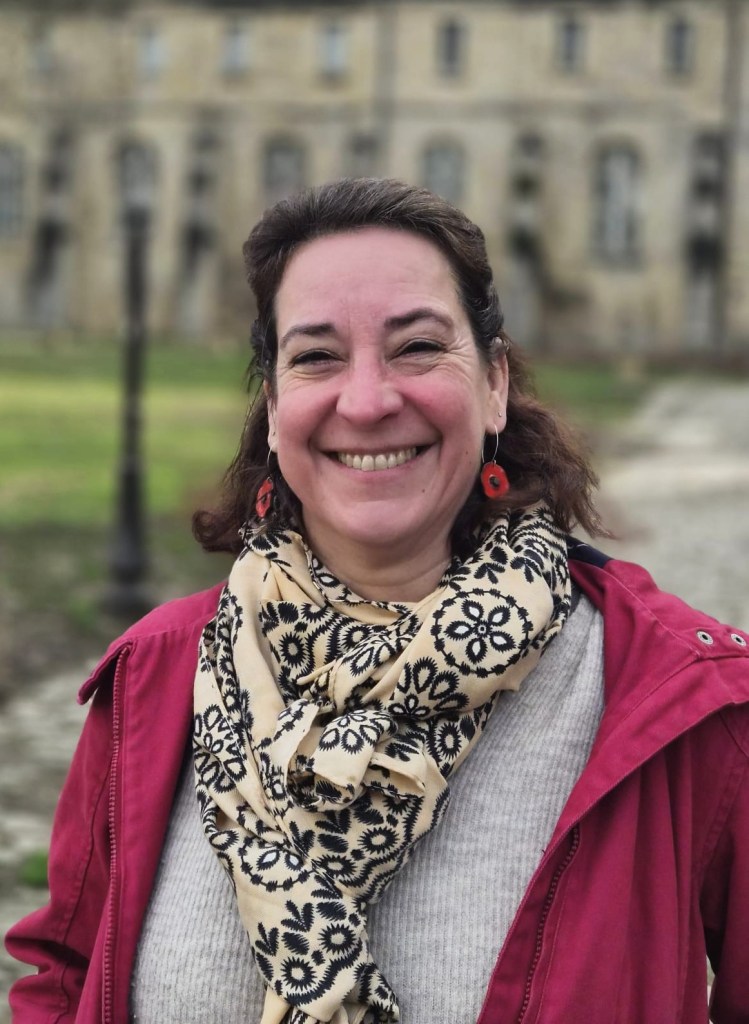
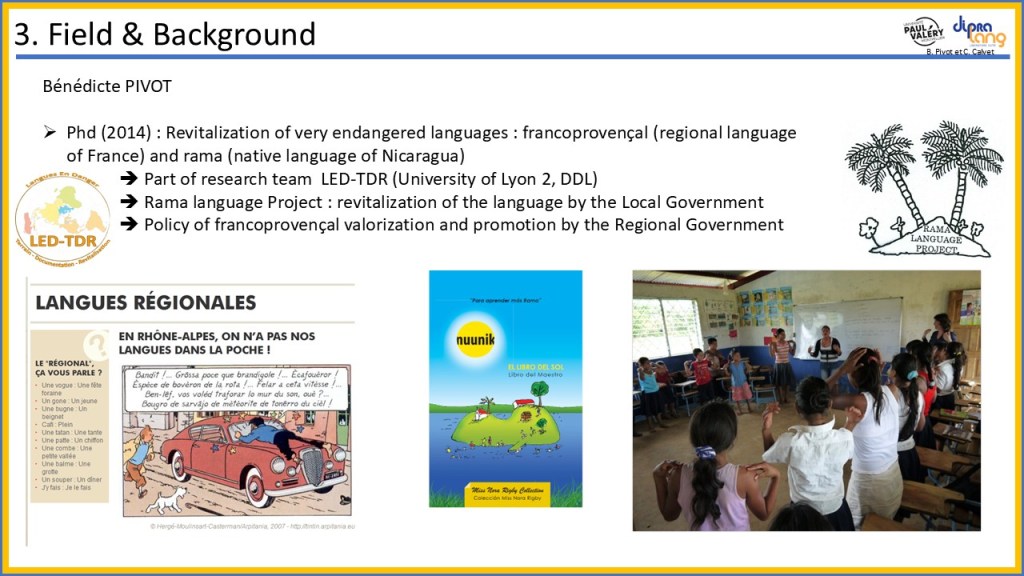
Bénédicte Pivot has been an associate professor at the University of Montpellier Paul-Valéry since 2015 and is a member of the DIPRALANG research laboratory. She specializes in the revitalization of very endangered languages and is particularly interested in the social issues and sociolinguistic practices related to the dynamics of revitalization, promotion, and heritage preservation of these languages. The main questions are why do the people reclaim language revitalization, when do they do it, what do they really ask for, or expect and what are the consequences. One of the principal focuses is about transmission of these minoritized languages: what kind of teaching approaches can be used to fulfill which social and communicational functions?
Her other area of expertise is the linguistic socialization of migrant women, particularly those who are illiterate in their first language. As a sociolinguist, she is interested in how these women are socialized and socialize in French society, what are their networks, and how this impacts their language proficiency. As an educator, she explores teaching and learning literacy skills approaches that are appropriated to this specific audience.
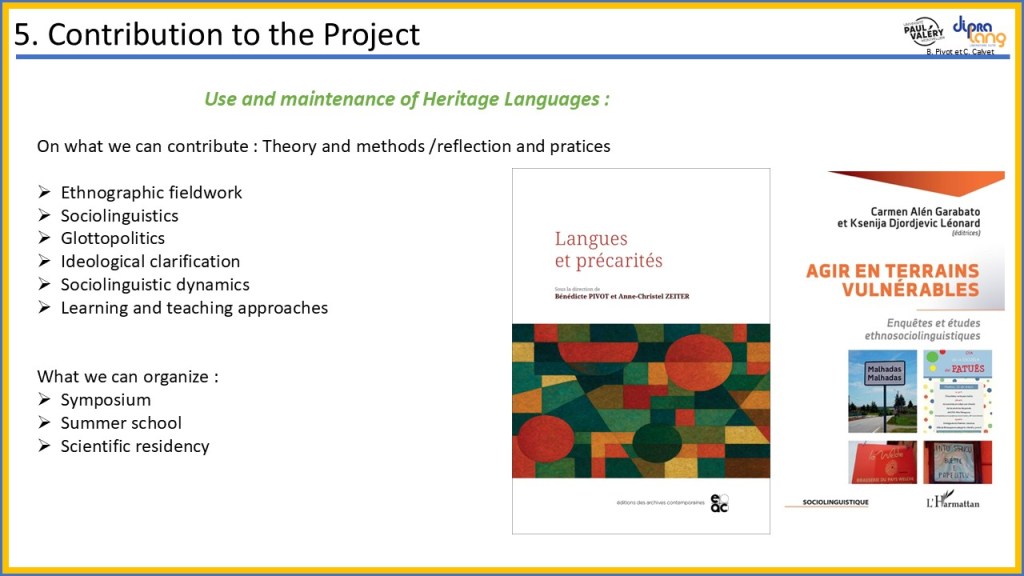
She recently published a book with Anne-Christel Zeiter that offers a theoretical exploration of language and precariousness in situation of transmission.
Pivot, Bénédicte, & Zeiter, Anne-Christel (Éds.). (2025). Langues et précarités. Editions des archives contemporaines.
Caroline CALVET
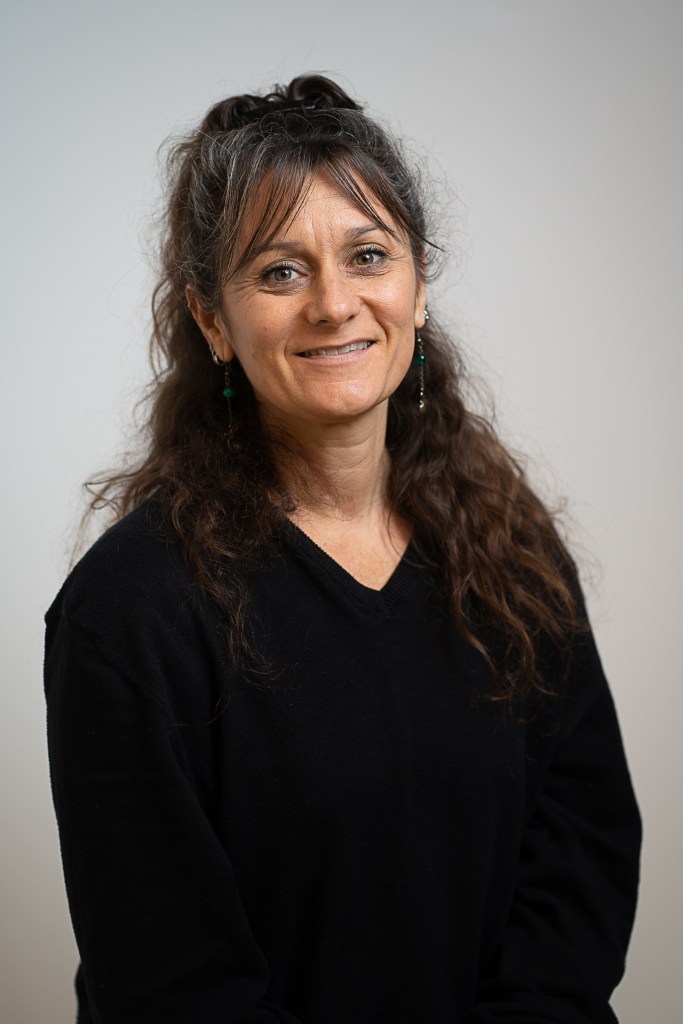
Caroline Calvet is a sociolinguist with a PhD, specializing in the Occitan speaking area, – Occitan is a regional language historically spoken in southern France. Her research focuses on the revitalization of regional and heritage languages, particularly on new speakers and processes of language re-acquisition. She introduced the notion of paradoxical new speakers to describe people who received the language in the family—but not directly from their parents— and who have benefited from formal instruction, and yet navigate a complex stance of self-identification: they both claim and do not claim their linguistic identity. She has also conducted research on Occitan toponymy from both dialectological and sociolinguistic perspectives, as well as research on the vitality of Occitan language in the field of music. Her research examines how these dynamics influence language policy and community-based revitalization efforts. She studies in particular spaces of practice, as places for revitalization and as laboratories for new speakers coming up.
Caroline is secretary of the Young Researchers in the Occitan Domain (Joves Cercaires en Domeni Occitan, JCDO), and, as such, she is a member of the Council of AIEO (International Association of Occitan Studies). She is also a founding member of the association Vulnerom, of which she is the treasurer.
Within the LocalLing project, Caroline will especially analyze teaching practices in multilingual contexts within formal and non-formal language transmission spaces.
Carmen ALEN GARABATO
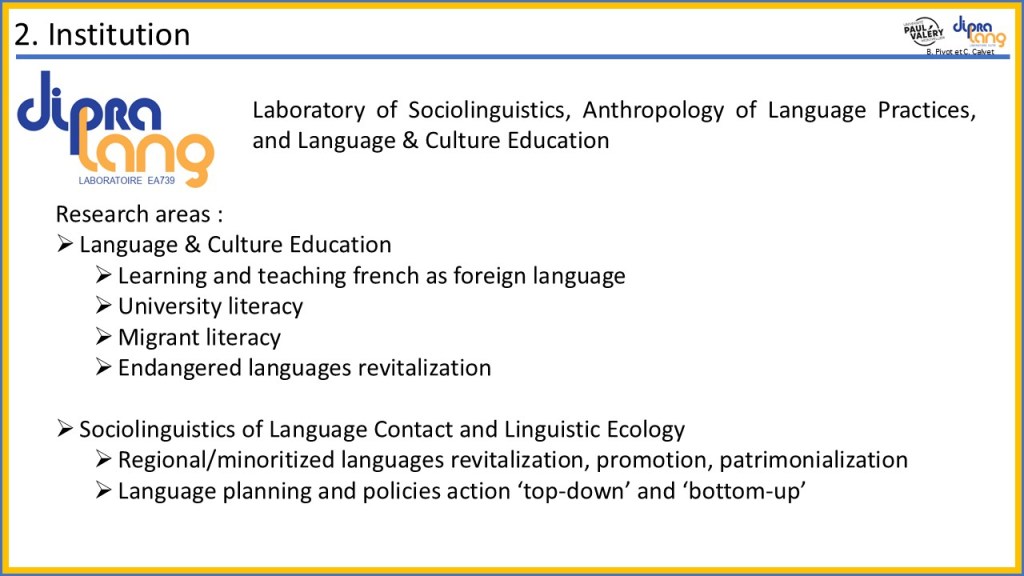
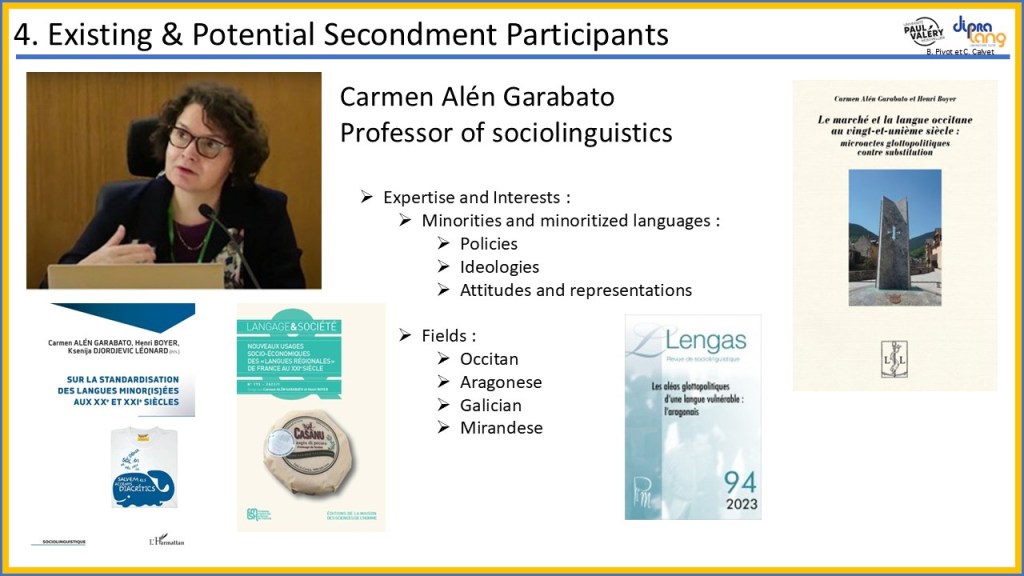
Carmen Alen Garabato is a professor of language sciences at the University of Montpellier Paul Valéry. Her teaching focuses on sociolinguistics, language policy, language rights and historical linguistics. From June 2019 to December 2025, she headed the DIPRALANG Laboratory (EA 739): Laboratory of Sociolinguistics, Anthropology of Language Practices and Language and Culture Education (https://dipralang.www.univ-montp3.fr/fr). She began her academic career at the University of Santiago de Compostela, in the Department of Galician Philology, within the Romanic Philology section. Her research in general sociolinguistics and applied sociolinguistics focuses primarily on the Occitan, Galician, Aragonese and Mirandese regions, where she has conducted a number of field studies that have resulted in a significant number of articles and books, published in French, Spanish and Galician.
https://dipralang.www.univ-montp3.fr/fr/annuaire_recherche/maria-carmen-alen-garabato
 LOCALLING